 Add to Chrome
 Add to Firefox
 Add to Edge
Reparameterization Flow Policy Optimization
Feb 03, 2026
Reparameterization Policy Gradient (RPG) has emerged as a powerful paradigm for model-based reinforcement learning, enabling high sample efficiency by backpropagating gradients through differentiable dynamics. However, prior RPG approaches have been predominantly restricted to Gaussian policies, limiting their performance and failing to leverage recent advances in generative models. In this work, we identify that flow policies, which generate actions via differentiable ODE integration, naturally align with the RPG framework, a connection not established in prior work. However, naively exploiting this synergy proves ineffective, often suffering from training instability and a lack of exploration. We propose Reparameterization Flow Policy Optimization (RFO). RFO computes policy gradients by backpropagating jointly through the flow generation process and system dynamics, unlocking high sample efficiency without requiring intractable log-likelihood calculations. RFO includes two tailored regularization terms for stability and exploration. We also propose a variant of RFO with action chunking. Extensive experiments on diverse locomotion and manipulation tasks, involving both rigid and soft bodies with state or visual inputs, demonstrate the effectiveness of RFO. Notably, on a challenging locomotion task controlling a soft-body quadruped, RFO achieves almost $2\times$ the reward of the state-of-the-art baseline.

Best-of-Both-Worlds for Heavy-Tailed Markov Decision Processes
Feb 03, 2026We investigate episodic Markov Decision Processes with heavy-tailed feedback (HTMDPs). Existing approaches for HTMDPs are conservative in stochastic environments and lack adaptivity in adversarial regimes. In this work, we propose algorithms HT-FTRL-OM and HT-FTRL-UOB for HTMDPs that achieve Best-of-Both-Worlds (BoBW) guarantees: instance-independent regret in adversarial environments and logarithmic instance-dependent regret in self-bounding (including the stochastic case) environments. For the known transition setting, HT-FTRL-OM applies the Follow-The-Regularized-Leader (FTRL) framework over occupancy measures with novel skipping loss estimators, achieving a $\widetilde{O}(T^{1/α})$ regret bound in adversarial regimes and a $O(\log T)$ regret in stochastic regimes. Building upon this framework, we develop a novel algorithm HT-FTRL-UOB to tackle the more challenging unknown-transition setting. This algorithm employs a pessimistic skipping loss estimator and achieves a $\widetilde{O}(T^{1/α} + \sqrt{T})$ regret in adversarial regimes and a $O(\log^2(T))$ regret in stochastic regimes. Our analysis overcomes key barriers through several technical insights, including a local control mechanism for heavy-tailed shifted losses, a new suboptimal-mass propagation principle, and a novel regret decomposition that isolates transition uncertainty from heavy-tailed estimation errors and skipping bias.
Finite-time Convergence Analysis of Actor-Critic with Evolving Reward
Oct 14, 2025Many popular practical reinforcement learning (RL) algorithms employ evolving reward functions-through techniques such as reward shaping, entropy regularization, or curriculum learning-yet their theoretical foundations remain underdeveloped. This paper provides the first finite-time convergence analysis of a single-timescale actor-critic algorithm in the presence of an evolving reward function under Markovian sampling. We consider a setting where the reward parameters may change at each time step, affecting both policy optimization and value estimation. Under standard assumptions, we derive non-asymptotic bounds for both actor and critic errors. Our result shows that an $O(1/\sqrt{T})$ convergence rate is achievable, matching the best-known rate for static rewards, provided the reward parameters evolve slowly enough. This rate is preserved when the reward is updated via a gradient-based rule with bounded gradient and on the same timescale as the actor and critic, offering a theoretical foundation for many popular RL techniques. As a secondary contribution, we introduce a novel analysis of distribution mismatch under Markovian sampling, improving the best-known rate by a factor of $\log^2T$ in the static-reward case.
Finite-Time Convergence Analysis of ODE-based Generative Models for Stochastic Interpolants
Aug 10, 2025Stochastic interpolants offer a robust framework for continuously transforming samples between arbitrary data distributions, holding significant promise for generative modeling. Despite their potential, rigorous finite-time convergence guarantees for practical numerical schemes remain largely unexplored. In this work, we address the finite-time convergence analysis of numerical implementations for ordinary differential equations (ODEs) derived from stochastic interpolants. Specifically, we establish novel finite-time error bounds in total variation distance for two widely used numerical integrators: the first-order forward Euler method and the second-order Heun's method. Furthermore, our analysis on the iteration complexity of specific stochastic interpolant constructions provides optimized schedules to enhance computational efficiency. Our theoretical findings are corroborated by numerical experiments, which validate the derived error bounds and complexity analyses.
Reparameterization Proximal Policy Optimization
Aug 08, 2025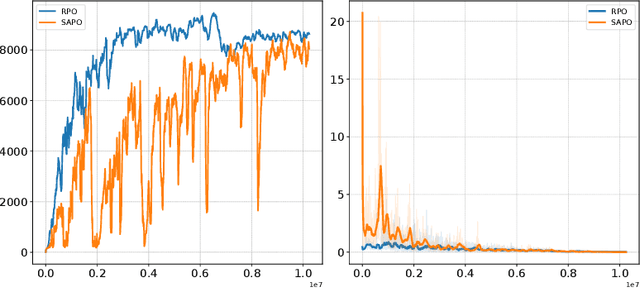

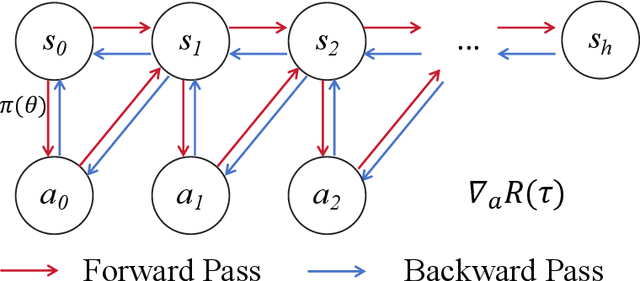

Reparameterization policy gradient (RPG) is promising for improving sample efficiency by leveraging differentiable dynamics. However, a critical barrier is its training instability, where high-variance gradients can destabilize the learning process. To address this, we draw inspiration from Proximal Policy Optimization (PPO), which uses a surrogate objective to enable stable sample reuse in the model-free setting. We first establish a connection between this surrogate objective and RPG, which has been largely unexplored and is non-trivial. Then, we bridge this gap by demonstrating that the reparameterization gradient of a PPO-like surrogate objective can be computed efficiently using backpropagation through time. Based on this key insight, we propose Reparameterization Proximal Policy Optimization (RPO), a stable and sample-efficient RPG-based method. RPO enables multiple epochs of stable sample reuse by optimizing a clipped surrogate objective tailored for RPG, while being further stabilized by Kullback-Leibler (KL) divergence regularization and remaining fully compatible with existing variance reduction methods. We evaluate RPO on a suite of challenging locomotion and manipulation tasks, where experiments demonstrate that our method achieves superior sample efficiency and strong performance.
OM2P: Offline Multi-Agent Mean-Flow Policy
Aug 08, 2025Generative models, especially diffusion and flow-based models, have been promising in offline multi-agent reinforcement learning. However, integrating powerful generative models into this framework poses unique challenges. In particular, diffusion and flow-based policies suffer from low sampling efficiency due to their iterative generation processes, making them impractical in time-sensitive or resource-constrained settings. To tackle these difficulties, we propose OM2P (Offline Multi-Agent Mean-Flow Policy), a novel offline MARL algorithm to achieve efficient one-step action sampling. To address the misalignment between generative objectives and reward maximization, we introduce a reward-aware optimization scheme that integrates a carefully-designed mean-flow matching loss with Q-function supervision. Additionally, we design a generalized timestep distribution and a derivative-free estimation strategy to reduce memory overhead and improve training stability. Empirical evaluations on Multi-Agent Particle and MuJoCo benchmarks demonstrate that OM2P achieves superior performance, with up to a 3.8x reduction in GPU memory usage and up to a 10.8x speed-up in training time. Our approach represents the first to successfully integrate mean-flow model into offline MARL, paving the way for practical and scalable generative policies in cooperative multi-agent settings.
Proxy-Free GFlowNet
May 26, 2025Generative Flow Networks (GFlowNets) are a promising class of generative models designed to sample diverse, high-reward structures by modeling distributions over compositional objects. In many real-world applications, obtaining the reward function for such objects is expensive, time-consuming, or requires human input, making it necessary to train GFlowNets from historical datasets. Most existing methods adopt a model-based approach, learning a proxy model from the dataset to approximate the reward function. However, this strategy inherently ties the quality of the learned policy to the accuracy of the proxy, introducing additional complexity and uncertainty into the training process. To overcome these limitations, we propose \textbf{Trajectory-Distilled GFlowNet (TD-GFN)}, a \emph{proxy-free} training framework that eliminates the need for out-of-dataset reward queries. Our method is motivated by the key observation that different edges in the associated directed acyclic graph (DAG) contribute unequally to effective policy learning. TD-GFN leverages inverse reinforcement learning to estimate edge-level rewards from the offline dataset, which are then used to ingeniously prune the DAG and guide backward trajectory sampling during training. This approach directs the policy toward high-reward regions while reducing the complexity of model fitting. Empirical results across multiple tasks show that TD-GFN trains both efficiently and reliably, significantly outperforming existing baselines in convergence speed and sample quality.
Continuous K-Max Bandits
Feb 19, 2025We study the $K$-Max combinatorial multi-armed bandits problem with continuous outcome distributions and weak value-index feedback: each base arm has an unknown continuous outcome distribution, and in each round the learning agent selects $K$ arms, obtains the maximum value sampled from these $K$ arms as reward and observes this reward together with the corresponding arm index as feedback. This setting captures critical applications in recommendation systems, distributed computing, server scheduling, etc. The continuous $K$-Max bandits introduce unique challenges, including discretization error from continuous-to-discrete conversion, non-deterministic tie-breaking under limited feedback, and biased estimation due to partial observability. Our key contribution is the computationally efficient algorithm DCK-UCB, which combines adaptive discretization with bias-corrected confidence bounds to tackle these challenges. For general continuous distributions, we prove that DCK-UCB achieves a $\widetilde{\mathcal{O}}(T^{3/4})$ regret upper bound, establishing the first sublinear regret guarantee for this setting. Furthermore, we identify an important special case with exponential distributions under full-bandit feedback. In this case, our proposed algorithm MLE-Exp enables $\widetilde{\mathcal{O}}(\sqrt{T})$ regret upper bound through maximal log-likelihood estimation, achieving near-minimax optimality.
Finite-Time Analysis of Discrete-Time Stochastic Interpolants
Feb 13, 2025The stochastic interpolant framework offers a powerful approach for constructing generative models based on ordinary differential equations (ODEs) or stochastic differential equations (SDEs) to transform arbitrary data distributions. However, prior analyses of this framework have primarily focused on the continuous-time setting, assuming a perfect solution of the underlying equations. In this work, we present the first discrete-time analysis of the stochastic interpolant framework, where we introduce an innovative discrete-time sampler and derive a finite-time upper bound on its distribution estimation error. Our result provides a novel quantification of how different factors, including the distance between source and target distributions and estimation accuracy, affect the convergence rate and also offers a new principled way to design efficient schedules for convergence acceleration. Finally, numerical experiments are conducted on the discrete-time sampler to corroborate our theoretical findings.
Few is More: Task-Efficient Skill-Discovery for Multi-Task Offline Multi-Agent Reinforcement Learning
Feb 13, 2025As a data-driven approach, offline MARL learns superior policies solely from offline datasets, ideal for domains rich in historical data but with high interaction costs and risks. However, most existing methods are task-specific, requiring retraining for new tasks, leading to redundancy and inefficiency. To address this issue, in this paper, we propose a task-efficient multi-task offline MARL algorithm, Skill-Discovery Conservative Q-Learning (SD-CQL). Unlike existing offline skill-discovery methods, SD-CQL discovers skills by reconstructing the next observation. It then evaluates fixed and variable actions separately and employs behavior-regularized conservative Q-learning to execute the optimal action for each skill. This approach eliminates the need for local-global alignment and enables strong multi-task generalization from limited small-scale source tasks. Substantial experiments on StarCraftII demonstrates the superior generalization performance and task-efficiency of SD-CQL. It achieves the best performance on $\textbf{10}$ out of $14$ task sets, with up to $\textbf{65%}$ improvement on individual task sets, and is within $4\%$ of the best baseline on the remaining four.